IE
Punlisher: The Deutsche Guggenheim (Editions), 2008
957 pages, Size: 13,4 x 21,4 x 3,3 cm.
The Oxford English Dictionary is the accepted authority on the evolution of the English language over the last millennium. It is an unsurpassed guide to the meaning, history, and pronunciation of over half
a million words, both present and past. It traces the usage of words through 2.5 million quotations from a wide range of international English language sources, from classic literature and specialist periodicals to film scripts and cookery books. It is the The definite record of the english language. I.E is a book that contains all of The Oxford English Dictionary’s example sentences.
Chanting Down Babylon — Recorded Accounts of EL AL FLIGHT 1862. Amsterdam, October 4, 1992
Publisher: argobooks and Halle für Kunst, Lüneburg, Germany, 2009
175 pages, 16cm × 24cm
Contributors: Eva Birkenstock, Hannes Loichinger
In 1992, shortly after its take-off from Schiphol Airport, a freight plane owned by the Israeli company El Al crashed into a residential complex in Bijlmermeer, Amsterdam. Dani Gal (*1975) visited the occupants of the Bijlmermeer district and journalist Vincent Dekker for the purpose of entering into a dialogue with them about the plane crash and reassembled everyday life in the reconstructed building. Based on comprehensive research, following the atmospheres and worlds of subjective memories and experiences, the artist‘s book gives an overview of various occurrences and stories woven into a complex structure of abstract and formal connections.
Historical Records
Publisher: Snoeck Verlagsgesellschaft GmbH, 2018
260 pages, 450 colour ills Contributor: Markus Gammel
The book Historical Records documents commercially released vinyl records of political events of the twentieth century. The book contains 450 reproductions of LP covers from 50 countries. The recordings are of speeches and interviews of those who were in power, others who objected to this power, of war and peace agreements, human rights struggles, and other radio broadcasts of the events that shaped history from the invention of the phonograph to the fall of the Berlin wall. The project examines how recorded political events turned into a commodity, and what role sound documentation has in the interplay between personal and collective/national memory.
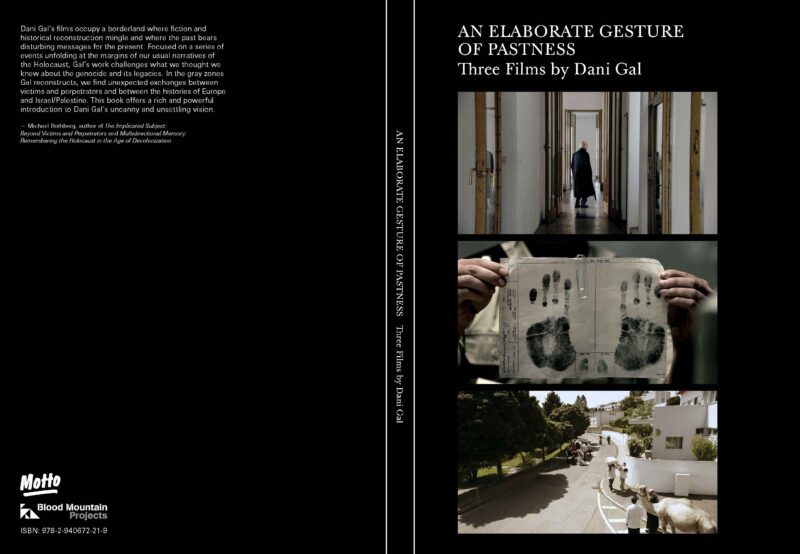
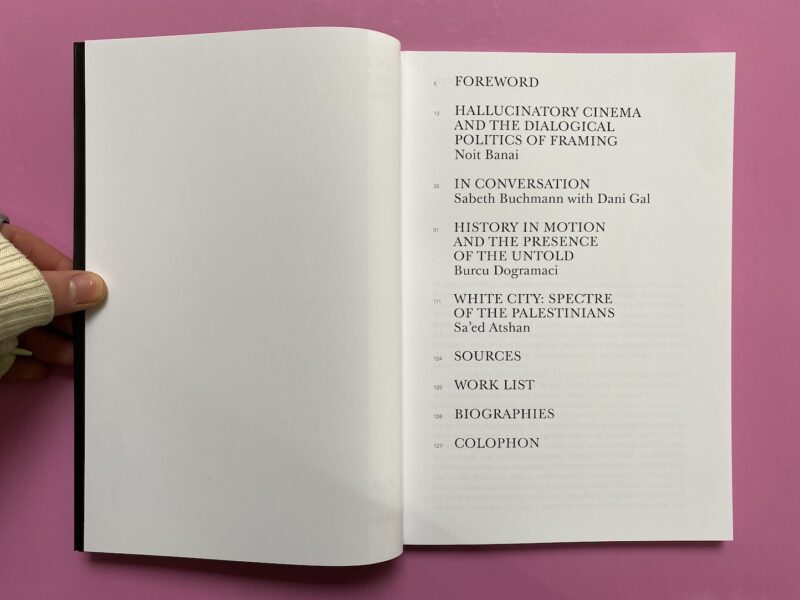
An Elaborate Gesture of Pastness: Three Films by Dani Gal, 2021 Night and Fog (2011) As from Afar (2013) White City (2018)
“Dani Gal’s films occupy a borderland where fiction and historical reconstruction mingle and where the past bears disturbing messages for the present. Focused on a series of events unfolding at the margins of our usual narratives of the Holocaust, Gal’s work challenges what we thought we know about the genocide and its legacies. In the gray zones Gal reconstructs, we find unexpected exchanges between victims and perpetrators and between the histories of Europe and Israel/Palestine. This book offers a rich and powerful introduction to Dani Gal’s uncanny and unsettling vision.”
– Michael Rothberg, Author of ‘The Implicated Subject: Beyond Victims and Perpetrators’ (2019) & ‘Multidirectional Memory: Remembering the Holocaust in the Age of Decolonization’ (2009)
The publication contextualises Gal’s film trilogy within the fields of memory politics, remembrance culture, Holocaust studies, decolonialism as well as film and art history.
With written contributions by Sa’ed Atshan, Noit Banai, Sabeth Buchmann, Burcu Dogramaci, and Dani Gal, the texts revolve around ethical, moral, historical and aesthetic dilemmas. Accompanied by visual and literary materials from Gal’s extensive research practice, the publication raises questions about cinema as an instrument for the production and reproduction of the real: dialogic versus fixed notions of history, unsettling empathy, historical trauma and the possibility of forgiveness in the context of German, Jewish and Palestinian histories.
Produced with generous support from the Bundeskanzleramt, Ernst & Olga Gubler-Hablützel Stiftung, Nationalfonds and Zukunftsfonds.
The rhythms you will hear meander and modulate, generating an expansive range of formal and affective possibilities—piercing, pulsating, thumping, bubbling, dripping, hissing, and creating sonic movements that have yet-to-be named. They infuse space and time with cycles of intensification and attenuation, enveloping you, dear listener, in layered texts and textures. Palimpsests of reveries and critical ruminations, they invite you to speculate: What might a global experience of the political sound like if apprehended through the collective unconscious of dreams?
Dani Gal recorded his own brain wave activity during different cycles of sleep as a basis for this electronic composition, which he later made on the historic EMS Synthi 100 – built in 1972 for the electronic studio at Radio Belgrade – by feeding the brain wave patterns into 5 filters. This sonic landscape, devoid of external sound sources and editorial interventions, operates as a minimally mediated index of the artist’s neurological activity, translated into an abstract auditory field. The resulting electronic composition of synthesized sound emerges from a non-linguistic system in which meaning is apprehended sensorially rather than semantically and, as such, resists narrative closure as well as symbolic interpretation. The intro track surfaces from the hypnic jerk or ‘sleep start’, an involuntary muscle contraction that occurs during the transition from wakefulness to sleep, often experienced as a brief jolt or sensation of falling and sometimes accompanied by vivid dream imagery or fleeting hallucinations. The main track – divided into part one and two on the record – stems from the brain’s activity as it falls deeper into sleep, a period when ‘sleep spindles’ generate bursts of rhythmic brain activity in the 11-16 Hz range, episodes that are thought to play a key role in memory consolidation. The outro track flows from the Delta wave, the deepest, most restorative sleep stage when dreams, if any, might involve feelings, bodily sensations, or simple images. Distributed between the artist’s involuntary brain-patterns, early synthesizer technology, and recorded voices, this dreamscape floats between time, space, and agents of authorship. With no access to the content of Gal’s dreams, listeners become intimate with what could be called the universal physiological condition of dreaming. The texts you hear – voiced with diverse accents and inflections – are selections of dreams by individuals who were subjected to various conditions of political oppression. Woven together are recollections of Indigenous Americans who documented dreamed- encounters with settlers; ordinary citizens in Berlin during the Third Reich; former enslaved people in North America; writers who lived in Stalinist Soviet Union; as well as the dreams of colonized peoples from around the world. This non-linear trans- historical and trans-geographic counter- archive challenges the conventional logic of the archive by preserving what is normally excluded, i.e., ambiguity, affect, anxiety, and helplessness. Nocturnal visions, journeys, and encounters – often considered fundamentally ungraspable, unreliable, or excessive – become a potent method through which to weave together the entangled histories and memories of modernity and coloniality. These experiences have often been excluded from official records because of their perceived negligence or illegitimacy. Emerging from histories of slavery, displacement, racial violence, and genocide, they were long invalidated because of the (western) archive’s demand for empirical proof and were, most probably, saved from disappearance through enormous risks and efforts by individuals and communities who understood their future valence. In Gal’s composition, these dreams become sites of survival and transmission, where trauma is neither neatly resolved nor silenced, but transformed into sonic and textual articulations that exceed rationalism. The resonances between trans-historical experiences of loss, resistance, fear, and longing suggests that dream life under oppression is not the property or privilege of a single group but rather the basis for a shared political struggle. Crucially, this solidarity is not based on sameness but a form of attunement: listeners are invited to feel history rather than simply observe it and to imagine futures rooted in shared, if fractured and unmasterable, remembrance.
This project expands on Gal’s longstanding unsettlement of the archive of modernity and coloniality and the epistemological, ontological, and political frameworks that position certain subjects inside or outside history and that draw clear lines of distinction between communities of remembrance. Sound unnerves the archive by implicating the listener in ways vastly different from the visual: It enters the body, vibrates through it, and collapses the distinction between observer and participant in ways that are not organized by a monologic optical authority but by multi-phenomenological resonance. Echoes, feedback, dissonance, and voices refuse to stay in their assigned temporal or political positions. Sound makes audible what dominant distributions of the sensible have rendered mute – hesitations, accents, breath, silence, noise and, importantly, the neurological frequencies and unconscious imaginaries of dreams. Critically, sound enables forms of empathetic connection that do not rely on identification as sameness. Listening to this record allows for disintegration: one can be moved, unsettled, or disturbed without claiming ownership of the past. In this way, Gal’s organized noises support dialogical networks of memory that vibrates across histories without collapsing their differences. “Go To Sleep and Look Around” functions as a biopolitical force that agitates the nervous system and makes history felt as tremor.
In the game, invented by the surrealist movement of the early 20th century, artists were invited to add to a sequence by being allowed to see only the end of what the previous artist contributed. In this version, we replace the pen and paper with sound-making objects, instruments, microphones, and recording devices.
Each participant is invited to create and record in-situ a 3-5 minute composition starting as a continuation from a 30-second recording made and left behind by the previous participant. This “continuation” of the 30 seconds can be interpreted freely, but it remains at any moment the only part audible from the whole project. No participant knows the entire piece until the end. The result is a ca. 40-minute composition to be revealed at a concluding listening session.
For the recording sessions, we lay out a table with various sound-making devices, musical instruments and effects. The invited artists engage with the objects and microphones on the table to create their track.
Each participant has up to 5 hours to create and record a piece on a given day (exact dates below) during the „Berlin-Karussell“ at A.D.K. As the project is part of an ongoing exhibition, the recording is done during opening hours, in the presence of visiting audience. In this way, it becomes performative.
Featuring a new collaborative composition by Dani Gal and Ari Benjamin Meyers, Nico von Wersch, Tony Buck and Magda Mayas, Manos Tsangaris, Labour, Marina Rosenfeld, Christian Naujoks
Dani Gal and Bernhard Schreiner’s improvisation act is based on a dialog between processed string instruments where the players respond both mechanically and intuitively to each other’s playing. Gal uses a device that translates sound sources into vibrations executed by small electric-motors to activate his guitar which by turn generates electronic noises through another device. During the concert Schreiner plays an Austrian Zither which he processes using bows, mallets, brushes, effect units and loops. His engagement becomes the live sound source that activates Gal’s devices. The conversation between the source and its instrumental translation creates unexpected call and response between the two players and the instant composition shifts between careful construction and rapid deconstruction.
DANI GAL, CHRISTIAN NAUJOKS. Concert – Presented by Yellow Solo at R50
Dani Gal uses a constantly evolving system that brings different sound sources—such as live radio, recorded sounds, and acoustic instruments outfitted with specially designed motors—into dialogue with each other. For example, when switching between stations on the radio receiver, the shift in sound level affects the movement of a record player that by result manipulates the sound on the record but also triggers oscillators. In relation to one another the sources, which the player has only partial control over, create an indeterminate musical composition.
Christian Naujoks plays an alternately tuned electric guitar with an electric bow and bottleneck slide; he layers the resulting long notes to create ambiguous harmonies and also incorporates pink/white noise and other sounds often used in tinnitus relief therapies. Through the interplay of consonance and dissonance, Naujoks blurs the boundaries between internal and external acoustic stimuli, sonic illusions, natural and synthetically generated tones. Culturally charged or standardized typical sounds often appear distorted, stretched, emptied, or shifted in his pieces.
In 1981 after a victory followed by over three years of struggle a record that documents the activity of 29 women who fought for equal rights in their company called “Heinze photo druck und papier” in Gelsenkirchen was pressed. The workers union published the record radio broadcast of the reports on the struggle, songs sung by the women and other voices that made this event.
Gal tracked down three of the women who took part in the struggle. The result is an installation made of a video showing the “heinze frauen” (The “Heinze women” as the press use to call them) listen to the record and reacts to the memories that the sound activates, a record player with the record and a film that was shot by one of the colleagues following the case court victory in Kassel in 1981.
In their project for the Frankfurter Kunstverein/Hessischer Rundfunk, Dani Gal and Achim Lengerer performed with DJ consoles in front of the audience to create a new “text” from documentary, political material of public speeches, political statements and other original soundtracks of the 20th century. The sonic performance was staged as a live broadcast with audience at the Hörspielstudio 7 and aired on hr2- on the 27th of November 2011.
As a sound and spacial installation, the project was part of the exhibition Demonstrations. Making Normative Orders at the Frankfurter Kunstverein (curated by Britta Peters) beginning of 2012,
Editing 4:1: Achim Lengerer and Dani Gal
Sound engineers: André Bouchareb, Roland Grosch, Ursula Potyra
Produced by: Ursula Ruppel Hörspielstudio Hessischer Rundfunk and Frankfurter Kunstverein, 2011/2012
The electronic composition Gal made on the EMS Synthi 100 at Radio Belgrade is based on the artist’s brain wave activity during cycles of sleep. Interlaced within the electronic sound are voices reading dreams.
These dreams found in historical sources were told by individuals who were subjected to various conditions of political oppression across histories and geographies.
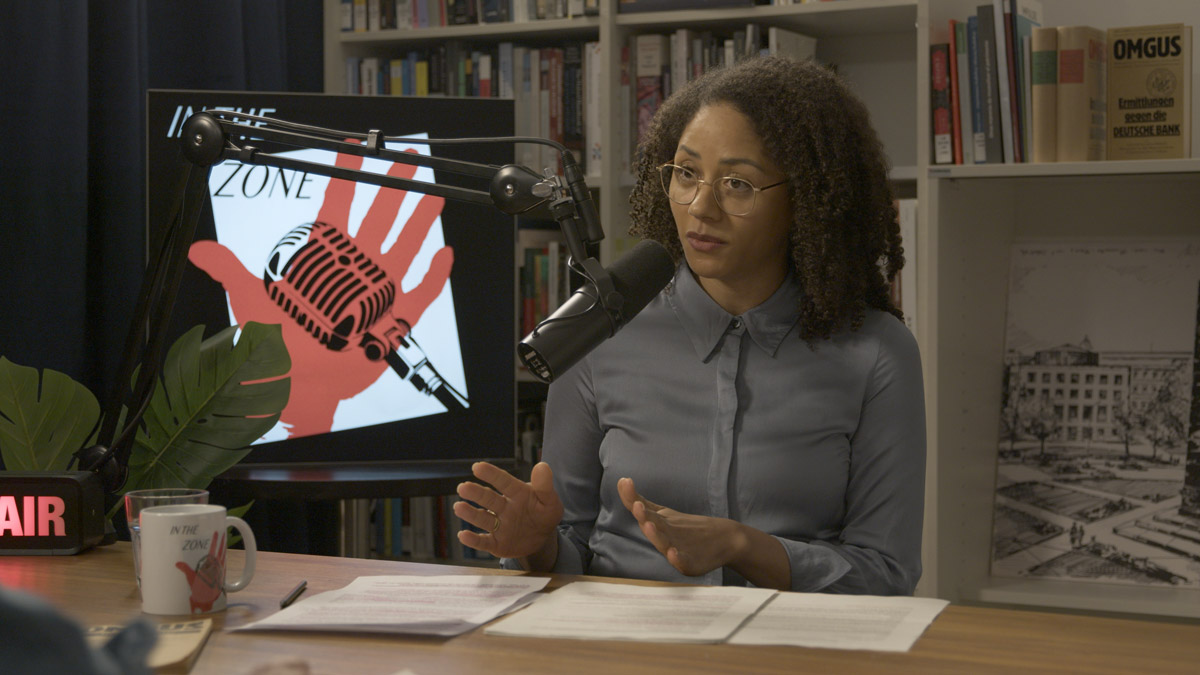
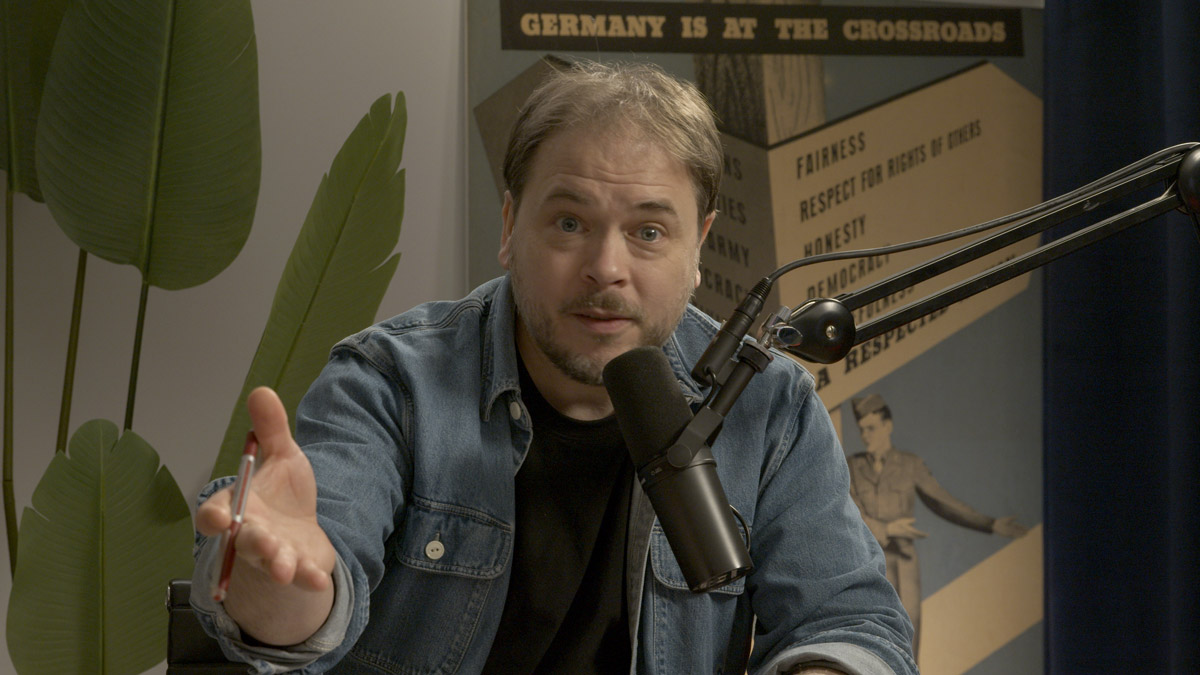
As Part of the process of denazification and democratic reeducation in occupied West Germany by the U.S. Military government in (1945-1952) military officials used surveys and studies to understand and influence the occupied population. Found in the OMGUS (Office of Military Government, United States) archives in Munich, are psychological surveys made by the U.S. military to map the democratic tendencies and the psychological attitudes of Germans who until recently lived under National Socialism. While reading these surveys from today’s perspective much of the information corresponds with current political debates in contemporary Germany regarding the rise of the far right, militarization, war, anti democratic tendencies of youth and the future of Germany.
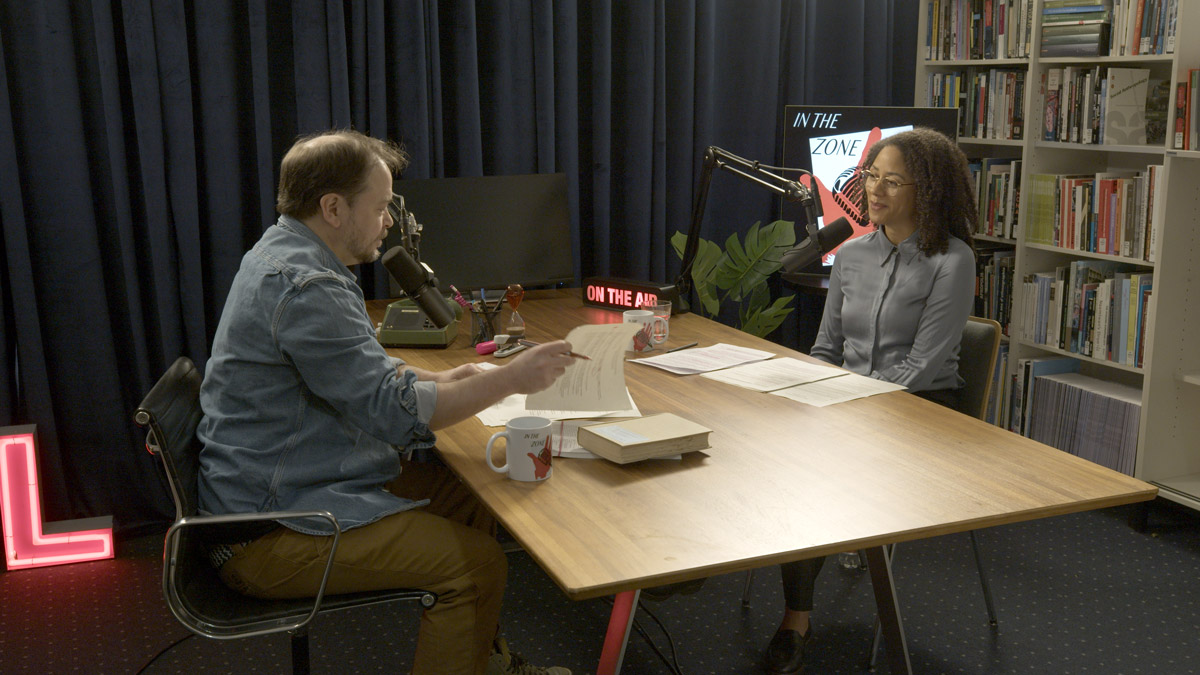
In his new video-work/podcast Gal transforms a selection of these studies into conversational forms and wraps archival material into the contemporary genres of video-podcast and TikTok selfie videos.
Written and directed by Dani Gal Camera: Itay Marom With: Lara Babalola and Daniel Stern Production: Heiner Schirmmacher Supported by: Hans Purmann Stiftung
Furniture music, or Musique d’ameublement in the original French, is a style of composition written by the French com- poser Erik Satie (1866–1925) from 1917 onwards. It is consid- ered the first “ambient” or “easy listening” music, designed to be played in the background rather than as a centrepiece. The name refers to the fact that the pieces are intended to “furnish” the room without attracting too much attention.
In 1980, the American composer John Cage (1912–1992) responded to Satie with a composition titled Furniture Music Etcetera. Particularly influenced by the idea of background music in his famous silent work 4’33”, especially Muzak (easy listening music played in office buildings), Cage used the piano parts from Satie’s furniture music and his own work Etcetera from 1973 to form a new composition for two pianos. The score consists of a timetable indicating which pianist is to play excerpts from either score. Durations are given, while dynamics, tempo and specific choices as to material are left to the performer.
In Gal’s work, the piano parts from the furniture music and Etcetera are each pressed onto a vinyl. The two record players built into the furniture sculpture are connected by a voltage control system. Each turntable motor is triggered by short dynamic sound events – known as transients – made by the piano on the other record. The piano pieces cause each other to play according to random automated elements. The composition thus reaches a new level of indeterminacy and becomes a new piece played by the furniture itself.
The curtains that divide the exhibition space are props from the concert scene with George Antheil from Gal’s film Three Works for Piano (2020). The geometric pattern comes from Marcel L’Herbier’s film L’Inhumaine (1924), which is primarily famous for its experimental approach to the medium of film and the involvement of numerous avant-garde artists in its music and set design. While L’Inhumaine met with criticism and incomprehension upon its release, its significance for film and art history is recognized today, particularly its synthe- sis of the various arts. The film also includes scenes from a concert at which dissonant compositions by George Antheil were performed and caused riots among the audience of extras – another source of inspiration for Gal’s film and the reconstruction of Antheil’s concert in Budapest.
Fotos: Daniel Sadrowski
Dani Gal, LAUTFIGUREN, Museum Ostwall, MO_Schaufenster #36, Dortmund
The thirty-five brass shapes are enlarged replicas of Eduard Sievers’s “Personal Curves” from 1915. The Leipzig phoneti- cian and linguist Sievers (1850–1932) developed a method known as “Schallanalyse” (sound analysis) to reproduce the original voice of an author and to capture the musical charac- teristics inherent in a given literary text.
As a way of representing different voice types, Sievers created a series of brass wire shapes that he called “personal curves”. These were based on observations by the musicologist Gustav Becking, who developed the curves from movements made while conducting; they are also known as “Becking curves”. These visualized curves, also referred to as “optical signals”, were then used in an experiment: several people read a text by Friedrich Schiller aloud while holding a brass wire in each hand. A phonograph was used to record the vibrations of their chest and larynx, which supposedly corresponded to Schiller’s original tonality and emphasis due to the brass forms. The question of whether such linguistic theories can be proven remains unanswered.
Dark continent, Written and Directed by Dani Gal, 25min, 2023 Dark Continent deals with the racial phobias resulting from the colonial imaginary and their transmission through music. His film is an adaptation of a case study from Martinican psychiatrist and anti-colonial writer Frantz Fanonʼs book Black Skin, White Masks (1952): a young White French woman suffers from a nervous disorder triggered by the sound of African drums—prohibited by colonial regimes and slave owners because they were suspected of carrying signals of rebellion.
Written and Directed by Dani Gal With: Yoli Fuller, Maj-Britt Klenke, J.David Hinze and Patrick Joswig Camera: Itay Marom Production: Kirberg Motors and Dani Gal
Vertiginous – An audio play With the backdrop of The Second World War and the Algerian War for Independence Vertiginous, a two part audio play tells the story of Camilla Mayer and Abdallah Bebtaga, two circus acrobats whose life is entangled through their steep rise to glory and tragic fall.
Part 1 Camilla
Part 2 Abdallah
Voice: David Wurawa, Alexei Korolyov, Alix Martin, Ewa Placzyńska
Produced by Ruth Anderwald + Leonhard Grond & Sergio Edelsztein
The film examines the roles of silence, silencing and listening in the politics of dominant national narratives and how socially accepted violence is constructed through the disciplines of witness testimonies in historical trauma studies and in post-colonial and post-Holocaust discourses.
The artwork reconstructs three piano performances of the 20th century avant-garde: John Cage’s seminal work 4’33 in the late 1970s, where the intended silence was interrupted by an Israeli audience’s spontaneous performance of a nationalistic song; the radical composer George Antheil’s confrontation of his audience with a loaded gun in a concert in Budapest in 1923; and the first documented art performance of a piano demolition by the Wiener Gruppe in 1959. The three events function as hallucinatory allegories to contemplate the complex dynamics between the historical witness and society.
This triangulation of performer-sound-audience is reflected in a recent real-life event, where the testimony of an Israeli soldier as a violent perpetrator in the occupied territories, was discredited and denied by the state. This negation of culpability sidelines the story from the real victims and exposes the soldier’s moral ambiguity.
Written and Directed by Dani Gal Camera: Itay Marom Produced by: Kirberg Motors and Blood Mountain Projects With: Itay Tiran and Dulcie Smart
Commissioned by Staatsgalerie Stuttgart on the occasion of the Bauhaus centennial, this staged television-style interview with Ludwig Mies Van Der Rohe depicts the architect late in his life, confronted with his time as the final Bauhaus director, and his refusal to take a political stance amid pressure from the newly established Nazi government and communist students. The interviewer confronts Mies about his unwillingness to take a political position amid pressure both from communist students and the newly established Nazi government. Focusing on the events that led to the closure of the Bauhaus by the Gestapo in 1933, including Mies’s meeting with Alfred Rosenberg, his meeting with a young Gestapo officer in an attempt to keep the Bauhaus open under the Nazi regime, and his interest to continue his practice in Germany, the film questions cultural notions of modern architecture as an aesthetic reflection of progressive humanistic values.
By examining the nature of the relationship between Mies and the Nazis, insight is gained not only into the climate of the last days of the Bauhaus and its clash with fascist forces, but also into historic and contemporary principles of morality.
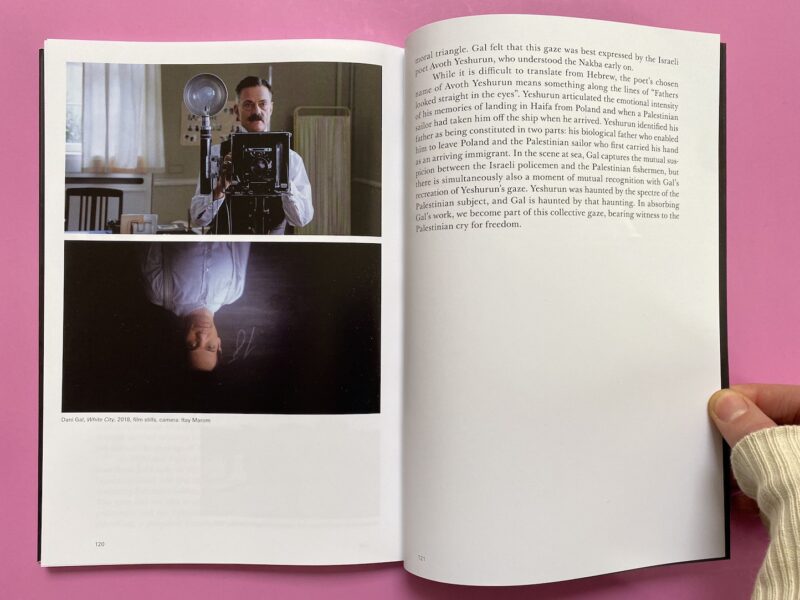
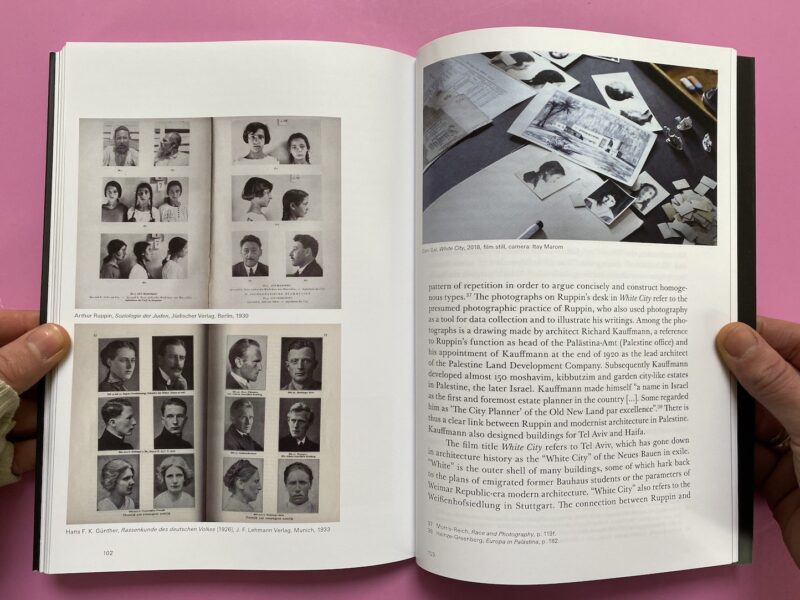
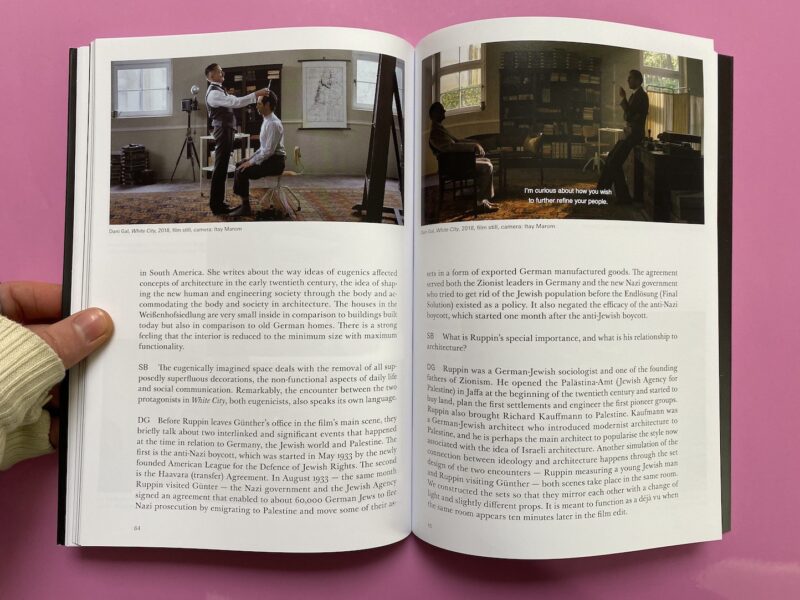
On August 16, 1933 Arthur Ruppin wrote the following entry in his diary: “Through Dr. Georg Landauer I travelled to Jena on August 3rd to meet Prof. Hans F.K. Günther, the founder of National-Socialist race theory. The conversation lasted two hours. Günther was most congenial but refused to accept credit for coining the Aryan-concept, and agreed with me that the Jews are not inferior but different, and that the Jewish Question has to be solved justly.”
The film revolves around the complex character of Arthur Ruppin (1876-1943), one of the founders of the Zionist Settlement who promoted coexistence with the Palestinians before the establishment of the state of Israel. Ruppin was also an enthusiastic researcher of the science of race, which explains his motive in paying a visit to Hans F.K. Günther (1891-1968), the German race researcher and eugenicist who later became a major influence on National Socialist racial thought. The film shows Ruppin as he visits the Weissenhof Estate, a neighborhood in Stuttgart famous for its modern architecture style, and experiences flashbacks which reflect his views. The monologues and dialogues within this film are based mainly on Ruppin’s diaries.
Camera: Itay Marom Production: pong film With: Alexander E. Fennon, Christian Harting and Yousef Sweid Art director: Merle Vorwald
A fictionalized account of Wiesenthal and Speer’s meetings, that uses dialogue based on their letters. Speer first wrote to Wiesenthal in 1974 after his release from prison, in an effort to accept some responsibility for his war crimes. His public admission of his moral misconduct impressed Wiesenthal, and they began a correspondence that lasted until the early 1980s.
Despite their profoundly contrasting personal histories, they shared common interests—both were trained architects and successful authors. They pursued their unlikely friendship despite controversy and occasionally visited each other. Gal takes this strange relationship as a starting point for a meditation on how historical events are recalled, recorded, and distorted.
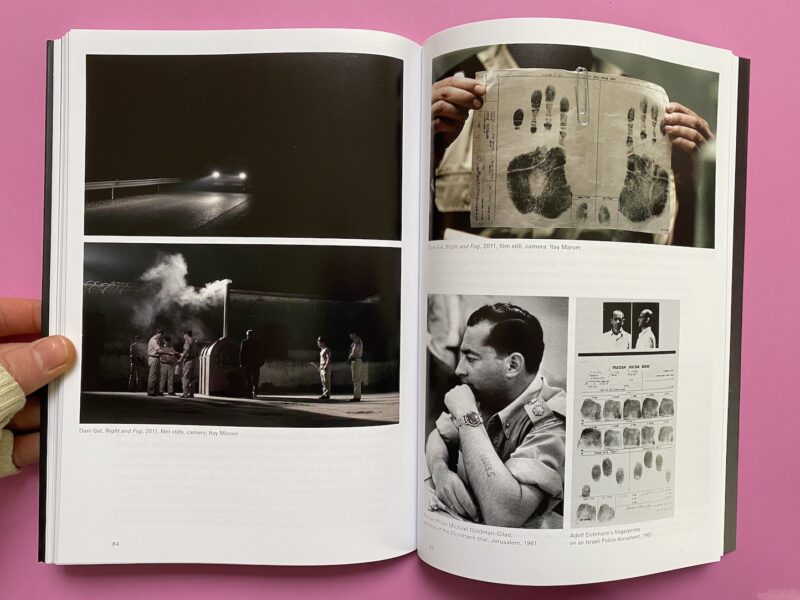
On April 11, 1961, the trial of Adolf Eichmann began. He was tried in an Israeli court and charged for committing crimes against humanity and war crimes. He was convicted and executed by hanging on May 31, 1962. On a night, between the 31st of May and the 1st of June 1962 shortly after the execution and the cremation of the body, a group of police officers sailed on a boat 6 miles off the shores of Jaffa port. Their mission was to scatter Eichmann’s ashes into the international waters of the Mediterranean Sea. The purpose of the highly secret mission was to ensure that there could be no future memorial and that no nation would serve as his final resting place. Based on an interview Dani Gal made with Michael Goldman, a Holocaust survivor who was one of the policemen on the boat, the film re-enacts the scene of the group of policemen sailing on a dark foggy night with Eichmann’s ashes in a jug of milk.
Camera: Itay Marom Production: Jonathan Dowek With: Yaron Mottola, Moris Cohen and John Fulton
Book of the Machines, Dani Galʼs new film, explores the fear of and fascination with the other by looking at automatons, primitive mechanical robots popular in the 19th century. Close-ups of these exoticized figures and their racial stereotypes are accompanied by excerpts from Samuel Butler’s novel Erewhon (1872), which describes a society that has banned all machines after recognizing that they might take over the world. This resonates with today’s debates on AI and its potentially demonic powers.
Written and Directed by Dani Gal Camera: Itay Marom Voice: Alix Martin
Historical Records is a collection of commercially produced vinyl records that documents recorded political events of the twentieth century. The collection contains over 700 LP’s of speeches and interviews of those who were in power, others who objected to this power, of war and peace agreements, human rights struggles, and other radio broadcasts of the events that shaped history from the invention of the phonograph to the fall of the Berlin wall. The project examines how recorded political events turned into a commodity, and what role sound documentation has in the interplay between personal and collective/national memory.
In Semi Automatic, Gal uses sound generating devices such as a radio receiver, recorded sounds or electro magnetic recorders to mechanically and electronically activate other sound sources, such as musical instruments. By using sound activated small electric-motors to vibrate string instruments which by turn generate electronic noises through another device Gal creates a dialogue between two or more sound sources. For example, by switching stations on a radio receiver, shifts in the sound level affect the movement of the motor that by result plays a string instrument.
In relation to one another the sources, which the player has only partial control over, create an indeterminate musical composition. One of the main aspects in this project is the use of speech. Through the radio receiver or pre recorded voices, speech acts as an activating sound source. When stimulating a motor that excites a string instrument it creates a sort of Speech Surrogacy; the practice of imitating verbal speech without the use of the larynx. When both the voice and the instrument braid into each other, spoken language become music.
Inherent Resolve installation view, America is Back, yellow Solo June 12—July 18, 2021
An actor is laying on the floor making a selfie video while addressing the viewer in an intimately seductive manner staged as a homage to Vito Acconci’s seminal video work “Theme Song” from 1973. In contrast to Acconci, who seduces the viewer, entices him or her to join him, and as a result points to the unbridgeable barrier created by the medium, the actor in Gal’s video recites audio messages broadcasted by the U.S. military through local Iraqi radio stations during the Battle of Mosul in 2016. During this battle, also known in the U.S. military as “Operation Inherent Resolve,” radio messages were designed as psychological warfare in an attempt to persuade ISIS fighters who were holding Mosul at the time to abandon their cause and join the U.S. backed authorities.
The radio is an acousmatic instrument. Listeners do not see the origin of the sound, their experience is shaped both by their own interpretation, and the manipulation of the producer in a political system. Our programs work on the space between documentary and Musique concrète. Each show focuses on political events that are connected to acoustic events. This creates an acousmatic documentary where the programs become sound-objects. The programs response to the ‘image saturated society’ discourse, by asking what is the function of sound as a document in times of live video feeds that can be broadcasted by anyone.
1) The Heavy Listener, 34:36min
Life between improvised music and Palestinian human rights. With Eyal Hareuveni. Live improvisation by Michael Thieke and Dani Gal
2) The Biennale is Fascist, 45:45min
The Student Movement of Venice tried to sabotage the 1968 Biennale while David Lamelas was changing the system from within.
With David Lamelas and Ciara di Steffano
3) Welcome to the Jungle, 43:27 min
Freedom Rock was used as a weapon in the U.S. invasion of Panama at the end of 1989 in what was a test case for American wars to come. With Peter Eisner (Washington Post)
4) Terra Nullius, 47:53min
Physical soundscapes from remote areas in Australia by Robert Curgenven echo the country’s colonial practices.
5) By November It Was Already Different, 45:02min
A conversation about Opposition and the Church in the last days of the German Democratic Republic. With Marianne Birthler and Rocco Pagel
6) December 7, 1989, East Berlin, 48:40min
The first meeting of the East German Round Table where members of East German citizen movements met with government representatives to discuss the future of the German Democratic Republic. With Elske Rosenfeld
7) Between Beirut and Gaza, 46:15min
Ghazi Barakat talks about growing up under the shadow of the Palestinian struggle and how this experience translates into his musical work.
8) A Wooden Cross, 47:52min
A trip to a village near Erfurt, where a small Ahmadiyya community wants to build a mosque. With Suleman Malik and Ricklef Münnich
9) Preservation is Visibility, 47:05min
The women behind the civil rights movement in the U.S. as documented in Irma McClaurin’s African American feminist archive, and Ryan Mendoza hijacking Rosa Parks’ house to Berlin.
10) Five Broken Microphones, 46:45min
Miriam Schikler recorded sound fragments from the reality of state violence against Palestinians in the West Bank as means of activism and music making.
11) Something is Going to Happen, 43:08min
The violent, xenophobic riots in Rostock-Lichtenhagen shortly after the unification of Germany. With Wolfgang Richter and Cornelia Schmalz Jacobsen
12) Under the Pavement Lies the Strand, 44:33min
A conversation about music and feminism. With Angi Domdey and Antje Greye
13) The Call of the Muazzin, 42:29min
The Israeli Government passed a bill that denounces the muazzin call to Prayer in mosques as noise pollution; meanwhile Pegida activists in Germany play it on their loudspeakers. With Abed Abu Shehadeh
14) Sounds of Our Fatherland, 45:33min
Shortly after the invention of the microphone Nazi Germany used field recordings to strengthen nationalistic feelings. With Yaron Jean
15) Decolonized Weather, 43:01min
Eitan Bronstein Aparicio uses diverse activities to decolonize Palestine. One of them is mapping destruction. He sent a map to Gaza and documented the trip.
16) Mulkelhood, 44:49min
Czech political prisoners in the communist era formed a special kind of brotherhood that lasted years after their release. With Jana Kopelentova Rehak
17) The American Sector, 39:26min
The role of RIAS (Radio in the American Sector) in post war Berlin, on both sides of the wall. With Dr. Joan Clinefelter
18) Frequency Anomaly, 47:04min
An Audio tape led to new discoveries in the Robert Kennedy assassination. With Shane O’ Sullivan and Philip Van Praag.
19) 3700 Hours of Recorded Tape, 44:08min
The Nixon tapes reenacted live in the studio by Jeff Burrell
The work refers to one of the key moments of post cold war American foreign policy – the invasion of Panama in 1989 and the apprehension of General Manuel Noriega. During Christmas 1989 Noriega had fled to the Vatican Embassy, whereupon the American military installed speakers and ‘blasted’ the Vatican Embassy building with Rock songs like Guns N Roses, “Welcome to the Jungle”, or Billy Idols, “Flesh for Fantasy”. This military operation was the ‘blueprint’ for dealing with future conflicts on many strategic aspects – one of which was the militaries control over the media.
a golden brooch object which is a replica of a clip-on microphone typically used in documentary films and interviews. It bears the title of a poem by Samuel Taylor Coleridge from 1798. This poem, which gives an account of the experiences of a homecoming mariner, was mentioned by the Holocaust survivor Primo Levi as an example of the necessity of reporting as a witness for those who can no longer do so. In this sense, the object signifies the moment of transference between witness and listener and the juncture between oral testimony and aural document.
Eleven American foreign policy experts from think tanks, military offices and the CIA, describe their perspectives on American foreign policy. These conversations, which revolve around such issues as Islam, the military industrial complex, American wars, cyber security and the notion of freedom, provide a soundtrack for scenes from an entire day in Washington D.C. The camera gaze over the city is mundane and banal. Monuments, nature and people, are given the same focus. This manner of filming the city provides an alternative to the iconic imperialistic cinematic representation of the American Capital.
By juxtaposing these non-iconic images with oppositional voices of strategy makers, those who promote certain agendas to the U.S. government, and others who harshly criticize it, the audience can take a distanced and critical view of America as a dominant hegemony or as an empire in decline. Electromagnetic fields in the city were recorded during filming as sound and then mixed with the general ambiance of the scenes. These sounds, which can only be heard using a special device, serve as a metaphor for the hidden forces that create what is called American power.
Lifta, a former village on the outskirts of Jerusalem, represents the tragedy of the Palestinians.
Their homes and culture, once a booming and wealthy village with more than 2500 inhabitants, had to flee in the 1948 Arab Israeli war. The abandoned village was at first settled with Jewish refugees from Yemen and Kurdistan, who on their part had been expelled from their Arab home countries as a result of the founding of Israel. However, Lifta was later partially deconstructed by blowing holes into the ceilings of buildings in order to prevent the return of Palestinians. In contrast to most Palestininan villages Lifta was never entirely destroyed, several plans to rebuild it as a neighbourhood and turn it into a luxury resort, have failed.
In close reference to Gordon Matta-Clark’s practice, and with a reversal of his title „Reality Properties: Fake Estates“ (1973), photographs, historical documents and news clippings ensemble a diverse illustration of a history where politics, economical interests and concerns of cultural identity are represented in architecture and structural characteristics. Using various techniques of printing and reference to sources, „Reality Estates: Fake Properties, Lifta“, does not create a linear narration of historical events or try to provide a specific political or moral point of view – it much rather functions as a lose assemblage of material that on one hand illustrates the diversity of the conflict itself. However on an abstract level, the work uses the purely formal character of the found architecture – holes in ceilings while the supporting walls seem stable. This gesture acts as another reference to Matta-Clark‘s work, with the distinction that these holes are the result of strategical and political destruction, rather than sculptural decisions made by the artist.
The phrase Sono vietate le discussioni politiche (Italian: Political Discussions Are Prohibited)refers to signs with the same message as they could be found in Italian bars in the 1930’s.
The video documents Hedy Epstein during her visit to South Germany where she returned to her village and stayed for two nights in the house she was displaced from as a Jewish child in 1939.
In the interview, Epstein is talking about her childhood in Nazi Germany, returning to Germany after the war, the Palestinians right of return, her attempts to enter the Gaza strip, her activities in the West bank, Hunger strikes and more.
The Video documents a visit to the Palestinian village Al Midya. The village which is located in the west bank, was used by the Israeli film director Ram Loevy, as a set for his filmHirbet Khiza (1978). This film was an adaptation of the controversial classic novella by the same name, by the Israeli author S. Yizhar, in which he describes the expulsion of Palestinian Arabs from their village by the Israeli Army during the 1948 Arab-Israeli War.
In the visit, Gal interviewed locals who remembered the film production, and the controversy surrounding its production. He screened the original film with a performance by a live translator, the rapper and actor Tamer Nafar, for the villagers. The resulting documentation was edited according to the original film narrative.
An architectural model used as a prop in the film “As From Afar”. The sculpture is simultaneously a miniature of the Mauthausen Nazi concentration camp and a model for a set, for a night scene in a fictional film.
Multiple frottage drawings of a grave stone of a British military drummer who died during the British colonial invasion to Palestine in World War I – the last war to use drums as an active battlefield instrument. Through the act of repetition in frottage making, and the repetition of hanging the multiple drawings in a sequence, the installation gives a sense of rhythm created by drumming. The title refers to the basic patterns used by musical drummers and takes its origin from military drumming.
At the beginning of the transcript of the 5th conversation between Morton Feldman and John Cage, the transcriber writes that in the middle of the paragraph the tape is damaged for 15 sec. Because of the damage, or the missing part, one can read the paragraph as a loop with a new meaning. I created a loop, a digital voice reading as Cage, with a break in the middle. The two are talking about the musician Edgar Varese who coined the term ‘organized sound’, as opposed to music. The damaged tape becomes a part of the composition in relation to the three composers and their conversation.
Krapp’s Last Tape is a one-act play, written in English in 1958, by Samuel Beckett. The play consists of a cast of one man and a tape recorder. The plot takes place on Krapp’s sixty-ninth birthday and, as has become his custom, he hauls out his old tape recorder to review one of the earlier years – in this case the recording he made when he was thirty nine and makes a new recording commenting on the events of the previous twelve months. The play is structured as a monologue/dialogue between Krapp and his voice recorded on tape. He listens and comments. Through the recordings Krapp reviews his own past, and slowly the audience understands that he has nothing left but his past as his voice on tape.
The play was adapted as a sound performance. The theatrical set of objects: Krapp’s desk, chair, the stage and the tape recorder were amplified using contact microphones – a type of microphone that amplifies vibrations into sound. When Beckett directed the play himself he instructed the actor to try to become one body with the machine, saying: “Krapp no longer owns the memories on the tapes. His mind is no longer capable of holding onto them”. Taking a musical approach to the play, the text is used as a musical score, while the objects are the instruments played by the actor, and the actor’s amplified movements become a sonic composition that is no longer attached to his body, but returns as a playback to the stage. The character’s behaviour conducts the way it will be heard by the audience. However loud audio feedback occurs, and the character becomes irritated by what is created by his own body – an analogue action that is his reaction to his recorded voice from the past.
A collection of Current Affairs Photos from different newspapers and magazines between the 70’s until today runs parallel too a collection of statements made by visual artists in interviews through the same period of time. Two slideshows play next to each other; one shows the texts the other shows the images. The viewer confronts the two as connected, obliged to impose a new meaning while, by confronting the texts and the images together. The news photos are being decontextualized from their reality and the artists statements are being observed in relation to images of “real” events.
The terror attack in the Munich Olympics in 1972 is one of the most iconic terror events in the history of the 20th century due of the special conditions, which it happened in, and the excessive media coverage. There are over 10 films- both fiction and documentaries that re-enacted this event. Using these films as a reference point, the video examines the mechanism of re-enacting historical events using cinematic and television tools, and show how the viewer’s understanding of an event can be changed through subtle changes in the characters looks.
In the films one can see how the terrorists entered the Olympic village dressed up in tracksuits to disguise themselves as sportsmen, changed to eccentric costumes like a safari suit and a cowboy costume, and woke up the sportsmen who slept in their underwear. Later German policemen wore tracksuits, in order to ambush the terrorists – again, disguised as sportsmen but wearing military helmets too, than changed to pilots costumes trying to ambush them in an airplane that was suppose to take them to Cairo. Finally the Israeli Olympic team wore tracksuits and other civilian clothing when they left the room where they were held hostage. The action of changing clothes and costumes during the event serves as a Leitmotiv and establishes the characters into the roles of those who were involved in the real event, but also the characters in the re-enactments. It is the connecting thread between the event and its representation through cinematic means.
During the video 11 men with the help of a costumes designer, constantly changed clothing, according to the plot re-enacted in the films and therefore constantly changing roles from being a victim to a perpetrator and back. two large double-sided mirrors (spy mirrors) were placed in the filmed room; these mirrors served as extras for the costume fittings, but also function as a window for the cameras to shoot from the outside. The use of the mirrors gave the video a look of a reality show like “ Big brother”, where people are put on display for 24 hours, and created an effect of multiplicity and resemblance of characters.
More than ten films, have re-enacted the terror attack in the Munich Olympics in 1972. The video shows these films layered on top of each other using transparencies. The films show the event in a chronological order, showing identical scenes of the event, but represented differently in each film – only the same characters appear similar to each other. Layering them on top of each other points at the gap between the event, its representation through media, and between each account. None of the films tell the exact same story.
This effect happens not only because of different interpretations of the event, but is also due to media standards and production values. The work examines the mechanism of re-enacting historical events using cinematic means, emphasizing different perspectives on how confusion is created about different roles and their evaluation in relation to this event.
Iancu Dumitrescu (Romania, 1944) is one of the leading avant-garde composers working today. His music is defined as spectral – a musical arrangement practice where compositional decisions are often informed by the analysis of sound spectra. During the last 30 years he has composed a large body of works for acoustic instruments as well as electro-acoustic compositions and music for tape and computer.
One of the key aspects of his work is the exploration of possible connections between the most archaic Romanian music, Byzantine music, and today’s Avant-Garde music. The video is an adaptation of a story Dumitrescu told in an interview about a dream he had during his military service in Romania. The dream, which had a very strong effect on the composer’s work, is an expression of sound in the most violent primary fashion in a context of an absurd military situation.
Urformen is a documentary about the avant-garde composers Iancu Dumitrescu and Ana Maria Avram. The video focuses on a visit to their house in a rural part of Romania and a to a museum in Romania that preserves ancient local ways of living which the composers take their inspiration from.
The phrase „The Shooting of Officers“ is taken from the book Fatal Words: Communication Clashes
and Aircraft Crashes (1994) by linguist Steven Cushing. One of Cushing’s fields of research examines misunderstanding in communication due to phonological, syntactical, and semantic polysemy.
Fatal Words takes a look at misunderstanding in aviation communication and can be read as a manual for the intelligible exchange of information as countless accidents in aviation result from misinter pretation by pilots and air-traffic controllers. „The Shooting of Officers“ is a sample phrase in Cushing’s book that is used to disclose multiple possible interpretations that follow linguistic ambiguity.
The work is a transformation of this phrase into a light sculpture that depicts a multiplicity of understandings by literally illuminating various meanings of the phrase and making the fragility of language and interpretation visible in letters made of glass.
Black Magic Marker’ shows musician and producer Lee ‘Scratch’ Perry in his current residence at Einsiedeln (Switzerland). The Lee Perry operated Black Ark Studio in Kingston, and its unique sounds central to the progression and promotion of the Jamaican music scene, mysteriously went up in flames in 1979.
Lee Scratch Perry, known as the ‘Upsetter’, psalmodises, in the midst of walls strewn with characters strongly reminiscent of his former studio, on divine power, animalistic objects and the power of symbols and words to become reality.
The work derives from a controversy around the classic Hebrew novella Khirbet Khizeh by Israeli author S. Yizhar published in 1949, in which he described the expulsion of Palestinian Arabs from their village by the Israeli Army during the 1948 Arab-Israeli War. The story became a bestseller, was included in the Israeli high school curriculum in 1964 and adapted into the television film in 1978, titled “Khirbet Khizeh”.
On February 15th, 1978, the film should have been shown on the Israeli TV. 90 minutes before the showing of the film it has been cancelled by the Minister of Education and Culture due to its content shedding doubt on the Zionist narrative. The unprecedented cancellation of a TV show through the government prompted protests against censorship from a coalition of artists, authors, lawyers, parliament members, journalists and TV technicians. However, the public polemic for and against airing the film became a fight for the freedom of information rather than an argument about the content of the film.
As result of this, TV newsmen vented their feelings by letting Israeli screens go dark for 50 minutes- the length of the controversial film, on the day after the Minister’s order.
The installation consists of three unsynchronized elements: The original sound track of the TV film Khirbet Khizeh was translated into English and adapted into a radio play with professional actors, combining it with an interview with film’s director Ram Loevy. The piece is played through a surrounding sound system. As a graphic translation of his audio work, the artist also adapted the optical soundtrack of the mentioned film, shown on a black and white television monitor. The visual result is a thin, moving and horizontal line. Among other references, this video projection relates to Nam June Paik’s Zen For TV, 1963, which shows astatic, white line running vertically across a black TV screen. Paik adapted his work into a second version where the line runs horizontally in 1976, the year the production of the TV film was started. For the presentation, I will show the video part of the work with the direct referens to “zen for tv” by paik witch is part of monuk collection.
Installation view Statement Art 41 BaselInstallation view, Statement Art 41 Basel, CH 2010Installation view, Statement Art 41 Basel, CH 2010